 AVANYSYS
Compliance at merge time
Schema and SQL changes are checked in the pull request, not caught in a later audit.
Self-healing governance
The Remediation Agent attaches fixes — like Iceberg column masking — directly to the PR.
No hot-path overhead
Agents read CDC metadata and query ASTs, never live payloads, so the streaming path is untouched.
Products · OmniMesh Compliance
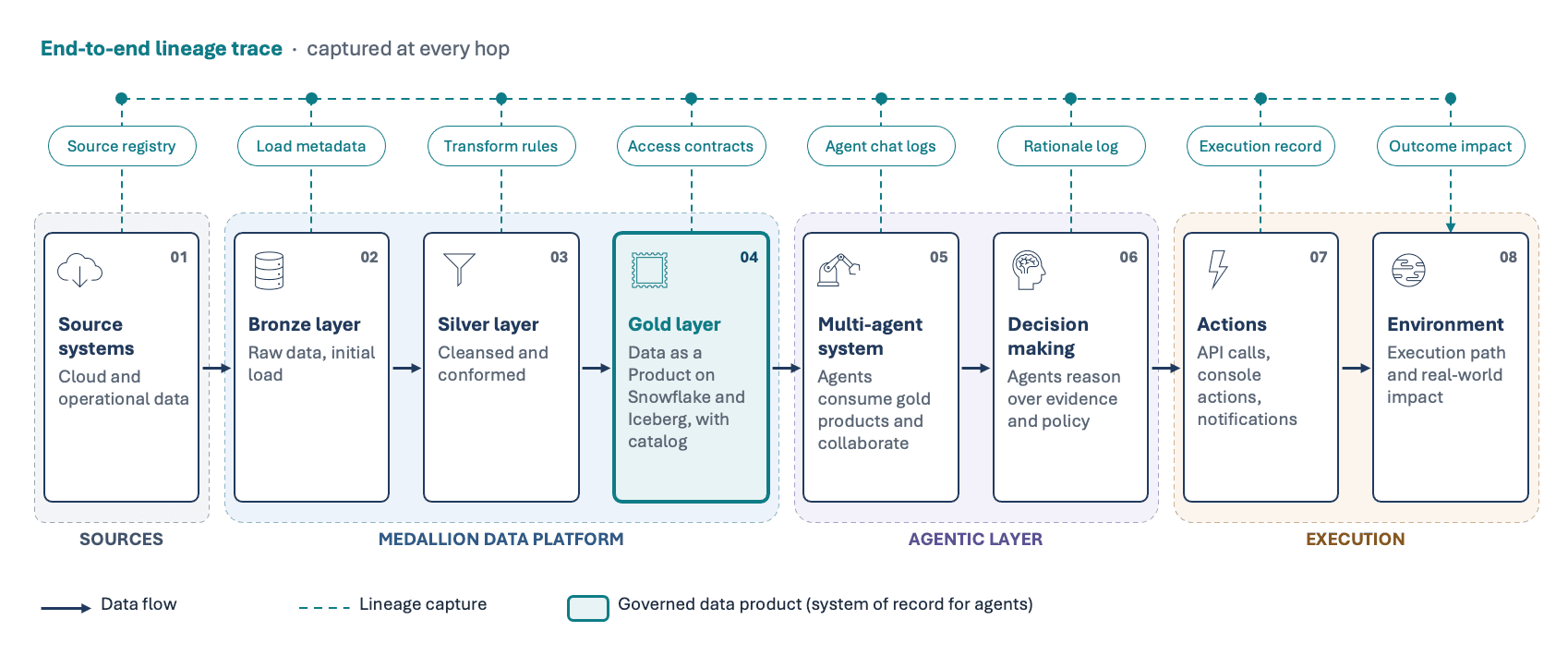
Every agent decision traces back through the gold layer to its source
Data meshes, streaming topologies, and open lakehouses now change through CI/CD, continuously. Regulation hasn’t caught up — governance is still manual, retrospective, and siloed. OmniMesh Compliance is an autonomous multi-agent engine that puts regulatory and lineage checks directly in that pipeline, so compliance is a build-time control, not an audit finding.
MULTI-AGENTDATA LINEAGEEU AI ACT · GDPR · EHDS · BCBS 239
WHY
Architectures evolve continuously through automated pipelines; governance has historically been manual and retrospective. OmniMesh closes that gap by embedding agents directly in the SDLC and execution plane, so a regulatory or lineage problem is caught in the pull request that creates it — not in next quarter’s audit.
How it’s built
A four-agent swarm, one orchestrator
Agents communicate asynchronously over a tool bus and a shared state graph, so each one can be reasoned about, tested, and replaced independently.
01
Pipeline Watcher Agent
Monitors schema mutations in Apache Iceberg, Hive Metastores, and Kafka topics via CDC logs — catches a drift the moment it's proposed, not after it ships.
02
Regulation & Policy Agent
Runs retrieval-augmented reasoning over curated EU AI Act, GDPR, and EHDS rulebases, grounded in human-curated text rather than open-ended legal interpretation.
03
Lineage & Impact Agent
Parses SQL dependency trees across the warehouse to score the blast radius of a change — which reports, models, and downstream agents would be affected — before it merges.
04
Remediation Agent
Drafts the fix: infrastructure-as-code, column-level masking policy, or a patch attached directly to the pull request that introduced the drift.
05
Master Orchestrator Agent
Owns the state graph across all four agents, decides what's safe to auto-apply, and routes anything above the risk threshold to a human for approval.
Self-explainable by design
Explainable through lineage, not through guesswork
OmniMesh doesn’t make its decisions explainable by exposing a model’s internal weights or attention maps — it makes them explainable by anchoring every decision to evidence a person can actually inspect. Ask “why did this get flagged?” and the answer traces backward through three things you can check yourself:
01
Lineage evidence
The Lineage & Impact Agent's dependency graph shows exactly which schema or query change triggered the review, and which downstream tables, reports, and agents sit in its blast radius.
02
A cited regulation, not a guess
The Regulation & Policy Agent grounds its finding in a specific passage retrieved from the curated EU AI Act / GDPR / EHDS rulebase — not an open-ended model inference.
03
A logged rationale, end to end
The Master Orchestrator records the full chain — trigger, lineage evidence, regulation cited, and outcome — in ClickHouse audit telemetry, so any decision can be reconstructed after the fact.
That’s the scope of the claim: OmniMesh is self-explainable about its own actions, via lineage and citation — it’s not a general solution to interpreting what happens inside an arbitrary AI model.
Business value
One lineage engine, three audiences
Grounded agent decisions
Policy reasoning runs over a curated rulebase, not an open-ended model guess.
Audit trail for every step
State, rationale, and escalations are logged end to end for later review.
Human approval where it matters
Critical production changes pass a human-in-the-loop gate before they apply.
Trusted metrics
Dashboards read governed gold-layer products that trace back to their source.
Blast radius before change
The Lineage Agent scores downstream reports before a schema change merges.
Regulator-ready reporting
Continuous lineage evidence supports BCBS 239 and AML-style audits.
Built for
Three regulated industries, one engine
Telecommunications
Cross-border telemetry, roaming data flows, regional subscriber privacy law, and real-time Kafka event streams that move faster than a manual review cycle.
Healthcare & HealthTech
Cross-border clinical trial data, secondary data usage under the EHDS, and strict HL7 FHIR access boundaries alongside HIPAA/GDPR obligations.
Financial Services & FinTech
Continuous lineage for real-time transaction processing, AML logging, cross-cloud database audits, and BCBS 239 reporting.
Under the hood
Technical stack
- LangGraph + MCP for stateful, tool-using agent orchestration
- Apache DataFusion / Ballista (Rust) for fast AST parsing of SQL query logs at scale
- Apache Iceberg tables, with Google Cloud Spanner for distributed lineage graphs
- ClickHouse for high-throughput audit telemetry
- Qdrant / Milvus vector stores for regulatory-text and playbook retrieval
See OmniMesh against your own pipelines
We’ll walk through what a schema change in your stack would trigger, and what it wouldn’t.